
Eye exams and vision tests are vital for assessing your eye function and health. Sometimes, these can be confused for the same thing, but there are significant differences between them.
An eye exam is a comprehensive evaluation of your vision and health conducted by an eye doctor (optometrist or ophthalmologist). In comparison, a vision test is a simplified assessment of visual acuity typically done by a school nurse or a family doctor.
Understanding the difference between these two can help ensure you receive the appropriate level of care for your eyes to maintain optimal vision.
What Is an Eye Exam?
Even without noticeable eye issues, you should have regular eye exams to evaluate your vision and ocular health. Eye exams can check for early detection of eye conditions and help monitor eye diseases, such as cataracts, glaucoma, and macular degeneration.

Eye Exam Procedure
Before an eye exam, your eye doctor will typically discuss the following:
- Family history of eye disease
- Medical history
- Whether you take or are allergic to any medications
- If you had eye surgery
- Your lifestyle and habits
- Whether you wear glasses or contact lenses
- Vision concerns you had in the past or have now
Tests conducted during a comprehensive exam can include:
- Visual acuity measures your vision at varying distances.
- Eye muscle function evaluates the muscles that control eye movement.
- Visual field test checks your peripheral vision.
- Refraction assessment shines light into the eye to see if it focuses correctly on the retina (the light-sensitive tissue at the back of the eye). If the light is focused in front or behind the retina, it can indicate a refractive error.
- Color vision test to check for color deficiency.
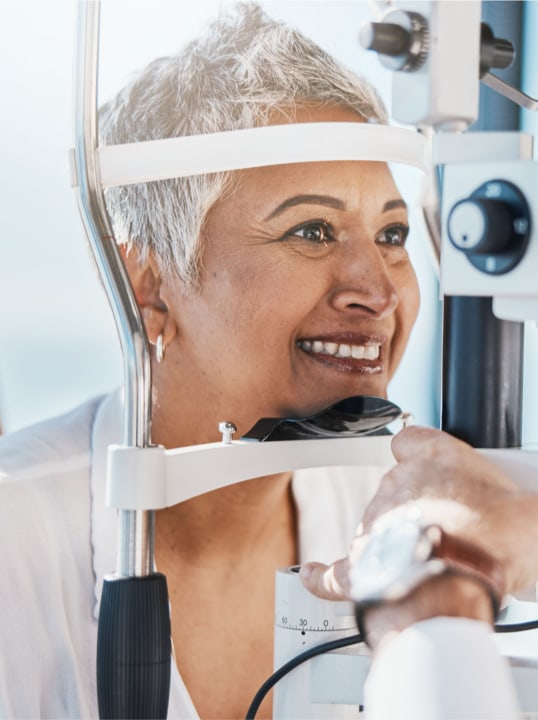
- Slit lamp to examine parts of the eye, such as the eyelids, cornea, iris, and lens of the eye.
- Dilation evaluates the retina, the optic nerve, and blood vessels at the back of the eye.
- Tonometry measures fluid pressure inside the eye to detect glaucoma.
- Binocular test to see how well your eyes work together.
How Often Should You Have an Eye Exam?
Your age, family history of eye conditions, and risk of developing eye problems usually determine the frequency of eye exams:
For Babies & Children
- Babies can have their first eye exam as young as 6 months.
- One eye exam between 3 and 5 years of age.
- One eye exam before a child starts kindergarten.
- An eye exam every 1 to 2 years for school-aged children or as recommended.
For Adults
- Once every 2 years for adults between 18 and 60 years or as recommended.
- Annually for adults over 61 years or as recommended.
What Is a Vision Test?
Vision tests or vision screening are basic tests to detect eye or vision issues. It’s a quick test, but without specialized equipment, there are limits to what it can diagnose, such as eye diseases. And if a problem is detected, you’d need to see an eye doctor for a comprehensive eye exam.
A vision test typically only measures distance vision by looking at letters or symbols on a Snellen vision chart. It is often a part of a routine physical examination or a school-based screening.
Because it’s not as extensive as an eye exam, it can’t diagnose any underlying eye conditions. Tests conducted during a vision screening can include:
- Visual acuity with a chart placed 20 feet away to check distance vision by covering one eye at a time and can be used to screen children over 3 and adults. It fails to check near vision or problems with eye movement.
- Eye and pupil inspection can check the shape and color of the eyes and how the pupils react to light.
- Photoscreening uses a special camera to identify refractive errors and other abnormalities in the eye. The test is automated, fast, easy, and used in community group screenings. A professional eye doctor can interpret the results if necessary.
Choose Comprehensive Eye Exams
Eye exams and vision tests serve different purposes. Eye exams are essential in maintaining good eye health and vision and can detect early signs of eye conditions. So, there is no replacement for a comprehensive eye exam.
Not all eye problems present with symptoms. If you’re overdue for a comprehensive eye exam, book an appointment with McCauley Celin Eyecare Associates today.